
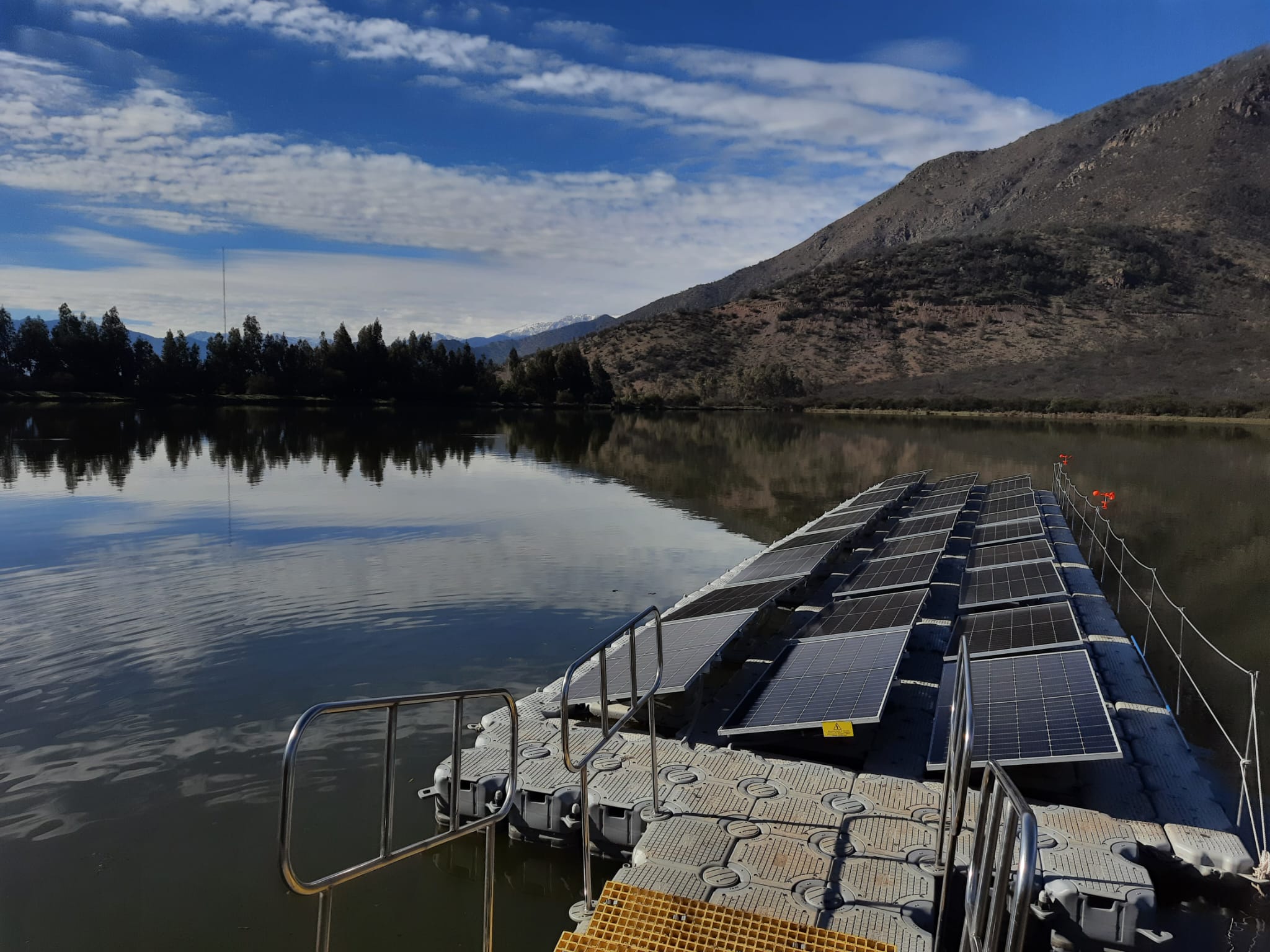
Backed by the Metropolitan Regional Competitiveness Innovation Fund (FIC-R), Fraunhofer Chile launched a pioneering initiative in 2020 to tackle two critical challenges at once: generating clean energy and preserving water resources.
Floating photovoltaics (Floating PV) is an innovative approach that involves installing solar panels directly onto water surfaces like lakes, reservoirs, or ponds. While the core technology mirrors standard ground-mounted systems—making implementation straightforward—the key difference lies in the floating platforms. This setup offers a dual advantage that is particularly transformative for rural areas: producing renewable energy while significantly mitigating water evaporation.
To prove the concept's viability, Fraunhofer Chile installed a pilot plant on the reservoir of the Canal Hospital Water Community in the municipality of Paine. Developed in collaboration with PUNTO SOLAR and DMC Consultores, the project aimed to demonstrate the technical, economic, and legal feasibility of Floating PV, generating crucial insights for the agricultural sector.
The facility features 30 monocrystalline panels covering 100 m². With a capacity of 16.2 kWp, the system is designed to generate approximately 23.6 MWh annually. Furthermore, Fraunhofer Chile has actively shared the expertise gained from this project with the Irrigation and Drainage Trade Association (Agryd), a network of over 130 firms and professionals dedicated to water management.
A Major Impact: Efficiency and Conservation
The benefits of this technology go beyond electricity generation. The water beneath the panels provides a natural cooling effect, lowering the operating temperature of the PV modules by 5°C to 10°C on hot days, which in turn boosts their energy efficiency.
However, the most striking impact is on water conservation. In a recent study, Fraunhofer Chile researchers monitored climate data and system performance for 280 days to quantify the technology's effectiveness. The results were compelling: Floating PV can reduce water evaporation by up to 81% in central Chile.
Projections indicate that on a one-hectare body of water, evaporation could drop from an estimated 16,000 m³ to just 3,000 m³ over a similar period. To put this into perspective, the water saved is sufficient to meet the annual irrigation demands of 1.5 hectares of crops, such as hydroponic lettuce.